Skip to content

Wireless thermostats are growing in demand in the UK, and for good reason, too. It has become easier to regulate heating with wireless thermostats and cut energy wastage and costs in the process. But one question comes up again and again:
Can I use any wireless thermostat with my boiler?
The short answer is no, not always. However, a detailed answer is worth understanding. This is because choosing the wrong thermostat could potentially be inefficient.
In this guide, we’ll cover how wireless thermostats operate, the boilers that are compatible with them, what to check before buying one, and how ECO4 grants can help you get a free upgrade to your heating system.
What Exactly Is a Wireless Thermostat?
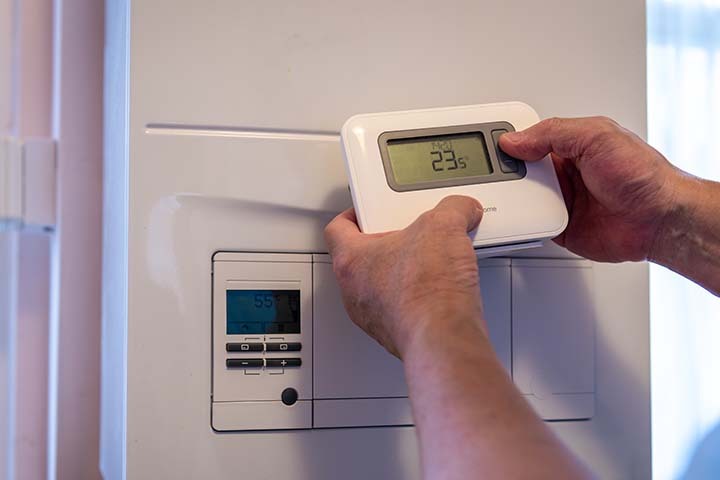
A wireless thermostat remotely controls the heating in your property without the need for wiring from the boiler. It communicates via radio signals or Wi-Fi, making it easy to install anywhere in the house. The new models also come with advanced technologies such as remote control and learning functions.
Core Components of a Wireless Thermostat System
Setting up a wireless thermostat is not about installing one device, but it is a system that typically consists of three parts:
Thermostat Controller
This is the unit with which you interact. It measures room temperature and allows you to set heating schedules or target temperatures. It may be wall-mounted or portable.
Boiler Receiver
Installed near the boiler, this unit receives signals from the thermostat and tells the boiler when to turn on or off – or how hard to work, if modulation is supported.
Means of Communication
This is how the thermostat and receiver talk to each other. This is where compatibility issues begin.
Wireless doesn’t mean universal. Compatibility with your boiler is required for functionality such as modulation, zone control, or smart energy savings. Proper pairing ensures comfort, efficiency, and reliable performance.
Radio Frequency (RF) vs Wi-Fi Control
| Radio Frequency (RF) | Wi-Fi-based Systems |
|
|
How Boilers Actually Communicate With Thermostats
The basic principle of a thermostat is straightforward: it should be able to communicate with the boiler to let it know if heat is required or not. The sophistication with which it does so – and how the boiler will respond – makes all the difference in efficiency and comfort.
Demand for Boilers
When the temperature in your home drops below the set point, a demand signal from the thermostat is sent to the boiler. The boiler then decides:
- Whether to turn on
- How much heat to produce
- How long to run
Not all boilers interpret that signal in quite the same manner. There are two main control methods used in UK homes.
On/Off System:
Thermostat → Receiver → Boiler → Full Power or Off
Modulating System:
Thermostat → Receiver → Boiler → Variable Heat Output → Steady Temperature
Why Modulation Matters
Modulation is not a mere enhancement – it is a complete change of what your heating system does.
Efficiency
- Less fuel is wasted during stop-start cycling
- The lower flow temperatures improve condensing efficiency
- Decreased use of energy over time
Boiler Lifespan
- Fewer ignition cycles
- Less thermal stress on components
- Lower risk of breakdowns
Comfort Consistency
- More stable room temperatures
- No sudden overheating or cold swings
- Quieter operation
Boiler Types in the UK and Thermostat Compatibility
Various boilers work in different ways when combined with wireless thermostats. This eliminates sub-standard performance and unnecessary upgrades.
Combi Boilers
Combi boilers are capable of providing hot water as well as central heating.
Typical Compatibility Scenarios
- Most modern combis support basic wireless thermostats
- Many modulate well, but only with particular brands or protocols
When Wireless Thermostats Work Well
- Single heating zone
- Simple schedules
- Compatible modulating controls
Common Limitations
- Absence of modulation when using an incompatible thermostat
- Less efficiency with ‘smart’ functions
- There will be no effect on hot water operations, but space heating suffers
This is because several combi boilers switch to on-and-off operation once they are connected to the wrong type of thermostat, regardless of the fact that both are modern models.
System Boilers
System boilers rely on having a hot water cylinder. They are ideal for family homes.
Cylinder Control Considerations
- All heating and hot water controls must be coordinated
- Wireless thermostats may control heating alone
- Hot water may still require separate controls
Hot Water Priority Issues
- Non-optimal thermostat connections could prioritise heating above hot water production.
- Poor compatibility can lead to inefficient reheating cycles.
Some smart thermostats oversimplify system boiler control.
Regular (Heat-Only) Boilers
Regular boilers work with tanks, cylinders, and external controls.
Zone Valves, Programmers, and Thermostats
- Several factors must come into play
- Wireless thermostats need to work with existing wiring.
- Compatibility is never easy
Why Compatibility Is More Complex
- These old systems were designed for basic controls.
- Faulty wiring may disable safety systems
- Inadequate integration may lead to heating issues or failure
In the case of heating systems only, wireless thermostats need to be considered as component parts of an overall control strategy rather than a direct replacement option.
Boiler Types and Wireless Thermostat Compatibility (UK)
| Boiler Type | Typical Homes | Wireless Thermostat Compatibility | Key Considerations | Best Control Type |
| Combi Boiler | Flats, small–medium houses | High |
| Modulating (manufacturer-approved) |
| System Boiler | Family homes with hot water cylinders | Medium |
| Matched heating + cylinder controls |
| Regular (Heat-Only) | Older homes with tanks & cylinders | Low–Medium |
| Full system-compatible control |
| Modern Condensing | Post-2005 installs | Variable |
| Modulating control |
| Older Non-Condensing | Pre-2005 properties | Limited |
| Simple on/off control |
Can I Use Any Wireless Thermostat With My Boiler?
No, you can’t use just any wireless thermostat with your boiler. Although wireless sounds universal, it only describes how the thermostat talks to its receiver, not how it controls the boiler.
Boilers vary in their controls (e.g., simple ON/OFF or modulating controls), meaning that if the thermostat does not support or match these controls, it may not function properly or function at all. Sometimes, homeowners may complain of high bills or uneven heating due to such reasons.
In order to steer clear of such issues, always check your boiler model and supported controls before choosing a wireless thermostat.
Brand Names and Their “Preferred” Thermostats
Almost all boilers work best with their manufacturer’s own controls. While third-party wireless thermostats are possible to integrate, these will often not offer more than simple ON-OFF control. Here are some common boiler brands and their preferred heating controls:
- Worcester Bosch: Works best with Worcester-branded controls like EasyControl. Third-party thermostats may have limited functions.
- Vaillant: Best with vSMART or ecoTEC controllers; third-party devices often default to simple on/off.
- Ideal: Compatible with Logic and Vogue controllers; newer models support modulating control.
- Viessmann: Prefers Vitotrol or Viessmann thermostats; generic units may limit performance.
- Baxi: Works with Baxi Connect controllers; high-efficiency models allow modulation.
- Glow-worm: Optimal with Glow-worm EasyControl; older boilers may only support on/off.
Always check the user manual of the boiler for recommended thermostats to ensure full control, efficiency in energy use, and warranty.
Are "Smart" Thermostats Automatically Better?
It’s assumed by many that all smart thermostats will automatically work out how to improve your heating and reduce bills, but it’s not necessarily the case. Yes, smart devices will learn your schedule, control multiple zones, and wirelessly connect to apps, but actual efficiency depends upon your boiler. Older boilers or those without modulation can’t use these features to full effect, meaning that a smart thermostat might just behave like an advanced timer.
Smart features will only save energy in reality if your boiler supports them; otherwise, convenience may come at a premium without reducing your bills.
Can the Wrong Wireless Thermostat Increase Energy Bills?
Incompatible thermostats may very well increase the cost of heating. They may reduce the efficiency of heating. Short cycling happens because of the wrong thermostats. In it, it switches on and off repeatedly. Other issues include temperature overshoot or improper flow temperatures. meaning the boiler works harder than necessary. Even if it seems to “work,” the wrong thermostat can reduce comfort and increase bills.
So, it is always important to consider compatibility. Incompatible thermostats can end up causing you to lose money in addition to shortening your boiler’s life.
How to Check Compatibility Before Buying a Wireless Thermostat
Before buying a wireless thermometer, it is essential to make sure that it is compatible with your boiler. If not, it may result in wasting your money. Below is a step-by-step process to follow.
Step 1: Find Your Boiler Make, Model, and Year
- Check the manufacturer’s label on your boiler or the user manual for the model and the year.
- Older boilers might only support an on/off signal and not a modulating control.
Step 2: Check Supported Control Methods
- Determine whether your boiler uses OpenTherm, an on/off relay, or some other proprietary control mechanism.
- Typical information that may be found is generally stated in the boiler manual or on the website of the manufacturer.
Step 3: Confirm Protocol Compatibility
- Thermostats use different wireless communication methods: RF (radio frequency), Wi-Fi, or some sort of proprietary signal.
- Make sure that the protocol fits your boiler’s receiver or control board.
Step 4: Check Manufacturer Guidance
- Check for lists of compatibility on the official websites of both your thermostat and boiler manufacturers.
- Some brands only ensure correct performance with their thermostats.
Step 5: Speak to a Qualified Heating Engineer
- A Gas Safe registered engineer will be able to check whether your boiler can support a particular thermostat.
- They can also offer advice on extra equipment that might be required, such as wiring centres or even relay modules.
Common Mistakes Homeowners Make
- Assuming “wireless” means it works with all boilers.
- Ignoring boiler age and control type.
- Purchasing a smart thermostat without considering the compatibility of the communication protocols.
- Attempting DIY installations without understanding wiring and boiler electronics.
Installation Considerations (What People Don’t Tell You)
Installing a wireless thermostat may seem like a very easy task, but there can be many hidden challenges that may cause problems:
- Wiring centre problems: Misconnections may result in short cycling or misfires.
- Receivers & fused spurs: Certain thermostats may require receivers to work in tandem with them. Incorrect installation can void warranties or create hazards.
- DIY errors: Even small things like reverse polarity can prevent proper boiler operation.
- Safety: Boilers involve gas and electricity, so only the Gas Safe engineers and qualified electricians should handle installations.
Expert advice or installation is your best bet when it comes to reliability.
Upgrade Your Boiler and Controls for Free Under ECO4
ECO4 grants aren’t just about upgrading old boilers but, rather, about efficiency in heating. This means that sometimes, controls and heating systems will be included with the boiler.
What ECO4 Covers:
Energy-efficient boilers, air source heat pumps, electric storage heaters, first-time central heating, loft and cavity wall insulation, and heating controls.
Heating controls are the key. A smart or wireless thermostat is included to ensure the heating is working well. This is required under PAS 2030/2035 installation standards. Without the proper controls, a new boiler may not be as energy-efficient, and the system could be more difficult to control and monitor. Upgrading the system and the controls simultaneously provides:
- Maximum energy savings
- Consistent temperature and comfort
- Full ECO4 compliance
The boiler, controls, and installation costs for eligible homeowners/tenants are all free for you. You pay nothing. That means you save money on your bills with a warmer home without paying a penny upfront.
Can ECO4 Include Wireless or Smart Thermostats?
Yes, but only under certain conditions:
- Certified Installation: Controls must be fitted by PAS 2030/2035-certified installers.
- System Optimisation: Smart thermostats have to optimise efficiency. This can be accomplished by managing heat storage in boilers, heat pumps, or electric storage heaters.
- Realistic Expectations: Not all smart thermostats are qualified. Devices must be compatible with the heating system, installed by a qualified person, and meet ECO4 standards of energy efficiency.
So, Can You Use Any Wireless Thermostat With Any Boiler?
Not all wireless thermostats are compatible with all boilers. The latest and best-rated boilers will be able to cope with all wireless thermostats, and those bought just a few years back will work well with smart thermostats.
Older boilers, some heat-only boilers, and some make-specific boilers may not work well with third-party thermostats. Using the wrong device may result in short cycling, inefficient operation, or potential damage. To get the best possible operating performance, it’s essential to consider the age of your boilers, use approved thermostats, and consider upgrading both boiler and controls together, especially under ECO4.
Frequently Asked Questions
Most boilers are compatible with popular smart thermostats such as Hive, Nest, or Tado, but it is always best to consult your boiler manual for more information on compatibility before purchasing.
Incorrect usage of the third-party thermostat may have some effects on the boiler guarantee at times. It would always be important to verify the information with the boiler company.
OpenTherm technology enables modulating control, which provides greater heating precision and energy efficiency. The technology finds its greatest applications with modern condensing boilers, but little with older on/off models.
Well, yes, particularly if your boiler is over 15-20 years old. Upgrading your boiler first ensures your new wireless thermostat works efficiently and does not just waste energy.
Yes, tenants can install wireless thermostats with their landlords’ consent. Furthermore, modifications should be within safety standards and should not affect current heating systems.